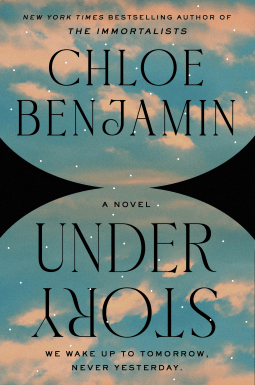
At the beginning of Chloe Benjamin’s newest book „Under Story,” Laurel Salter, who is a mycologist, leaves her position at a university for a research center in Antarctica. She takes a simple job as a kitchen steward, trying to find a place where she could find herself again and somehow come to terms with a great tragedy that happened to her and her husband at the time, Eli: they lost their son. Silas drowned while under Laurel’s care because she allowed her scientific curiosity to suppress her maternal instinct. That momentary slip in judgment had grave consequences and forever changed her and Eli’s lives.
In Antarctica, she discovers a phenomenon that surprises everyone: the beautiful Arc appears, and although nobody knows its purpose, Laurel gets an answer in a dream: it’s a portal to another world, the Duoverse. For months, her husband, a physicist, chased the theory that we don’t live in one universe. Another world exists where time runs backward. Soon Eli arrives at the Antarctic research station to study the mysterious Arc, and although they are divorced, they are united by grief and decide to try to reach the Duoverse.
It’s a fascinating idea, but the novel’s strength, for me, lies not in its speculative elements but in how Laurel, Eli, and other characters develop throughout the book. We follow Laurel and Eli through the years like a family saga, as the characters slowly grow on you after you see their youth; Laurel often spends time at the family orchard, and then you witness Eli and Laurel fall in love, trust each other, and lose that precious connection. It’s a great story of love, grief, and search for redemption.
However, for me, the second part of the book, when the author takes us into Duoverse, wasn’t as good. Somehow, the details describing the Duoverse rules became increasingly important, and the author spent more time explaining them. People there had their parents “born” in cemeteries, as the old people, but with the brain of newborns, who slowly were getting younger and stronger. Laurel met the same people she lived with in the other world, but the relationships were completely different; for example, her mentor was now her student. I became less immersed in the book and more critical of its explanations. Still, some things were unexplainable to me. It reminded me of how another novel, “Katabasis” by R.F. Kuang, handled the other world, in this case Hell, which also left me somehow unsatisfied. Creating a different world and explaining its conventions over many pages is a difficult artistic undertaking.
“Under Story” is still a beautiful book, and its flaws don’t lessen its slightly melancholic vibe and mesmerizing style. If we could turn back time, would our lives become better? Or would they be only different, with the same amount of joy and sadness, just distributed differently?
UNDER STORY by Chloe Benjamin, published by G.P. Putnam’s Sons, 2026


Leave a Reply