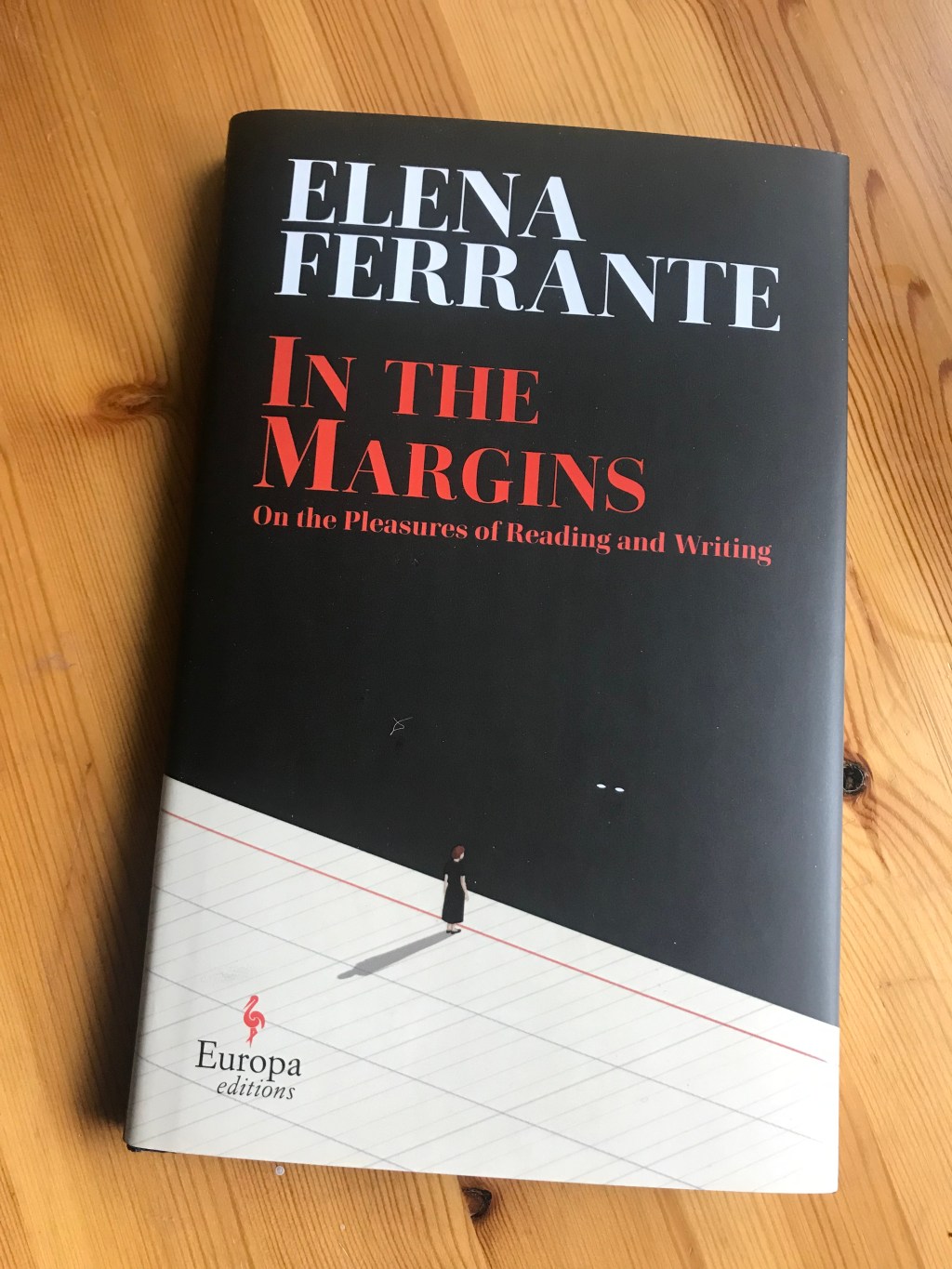
I noticed Elena Ferrante’s book In the Margins in a nearby bookstore at the same time when I was watching the HBO series My Brilliant Friend based on Ferrante’s Neapolitan Novels. Beautiful cover, thin book, interesting author, supporting the local bookstore (the order of my motives is random), so soon I was walking down the street with a book in my bag.
This is a collection of four essays, three of which were written as planned lectures at the University of Bologna, but due to the pandemic, the lectures did not take place on the scheduled time (they were supposed to be for three consecutive days, open to everyone and talking about the creative process of Elena Ferrante) and only later, in November 2021, they were read in the theater by the actress.
Perhaps the genesis of these essays has made them read a bit like lectures, a tad too scholarly for my taste. Ferrante analyzes his writing process. She writes about how important it was for her to find her voice. As a reader, she noted that most of the literature is patriarchal because it is written by men. Of course, there are eminent women writers, but she, as a young person, came into contact mainly with the writing of men. I must admit that it was also my experience.
Another problem while writing is extracting the right words from the wealth of the word repository in our minds. What makes the “hand of choice” reach for this and not another word? Ferrante says that her writing is based on experiences, specific people, places, and smells. How to describe a given situation so that it becomes more than a simple description? Our literary language, as indicated by Ingeborg Bachmann, is different from that of 100 years ago. This old one is referred to as “bad language”, a language that sounds false in the mouths of a modern writer.
Ferrante recalls another book, The Autobiography of Alice B. Toklas written by Gertrude Stein as a fascinating and groundbreaking work for her. Gertrude Stein wrote the autobiography – not biography – of another woman, her friend, and lover, and the subject of her work as well as she, the writer, connected on a very special level.
In the margins are very interesting reflections showing the importance of thinking and searching in writing. Writing itself is only the result. In the case of Ferrante, extremely successful.
 Infinite Books
Leave a comment