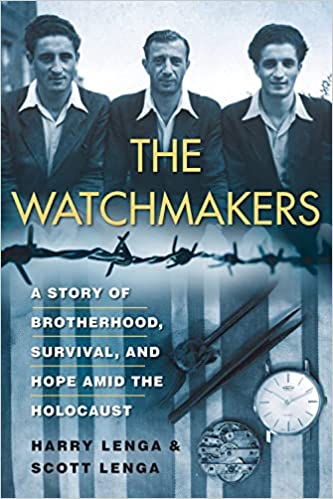
I have read several books, both novels, and memoirs on the same subject, however, this one takes a special place. The Watchmakers is a book written in first person, in the form of a diary, the result of hours of Scott Lenga talking to his father, Harry. Harry (Khil) describes his and his two brothers’ fates: from childhood in a family of Chassidic Jews in the small Polish town of Kozhnitz, through his teenage years in Warsaw, but the main part of the book tells about the WWII period, when the brothers tried to survive the Holocaust, going through Gorczycki Camp at Wolka, Wolanów Slave Labor Camp, Starachowice Slave Labor Camp, Auschwitz, and Ebensee camp, liberated in 1945.
Harry talks about everyday life in the camps simply and poignantly. Survival depended on health, age, and finally on luck, but also on creativity, hope, and faith. Many times, when one of the brothers was close to giving up – and giving up meant a quick death – Harry argued that they had to fight to the end, not let the Nazis win. The fight meant, for example, making sure to show up shaved at Aushwitz Sunday assemblies, because unshaven, sick-looking people were selected for immediate execution. The brothers’ great asset was their profession – as skillful watchmakers, they were used by the Germans to repair watches, usually stolen from Jews, and such work allowed them to spend time inside a warm room for at least a few hours. They also had the rule to stay together as a family and not to be separated, as much as it was possible. That closeness, hope, and ingenuity, as well as trying to keep their religious traditions alive, helped them to survive while many others around them perished.
The book is simply addictive. I followed and “cheered on” the brothers, so to speak, marveling sometimes over Harry’s resurcefulness. I also cried reading some of the harrowing pages.
Scott Lenga writes: “As far as I can remember my dad insisted that something like the Shoah could happen again in America or anywhere else”. Reading this, I remembered the words of another Auschwitz survivor, Marian Turski, who on the occasion of the 75th anniversary of the liberation of Auschwitz, said: “Auschwitz did not fall suddenly from the skies. It was approaching pitter-pattering slowly in those tiny steps until it happened. Do not be indifferent”.
And this is perhaps the greatest lesson we can take from this important book.
“The Watchmakers: The Story of Brotherhood, Survival, and Hope Amid the Holocaust”, by Harry Lenga and Scott Lenga, published by Citadel, 2022
 Infinite Books
Leave a comment